FESAL method - Final Evaluation of Self-Assessment of Learning
1. Introduction and Vision of the Business Model
The Lada Center Institute is based on a visionary business model that places a completely free approach to individual education at its core. We believe that learning is not a predetermined mold, but rather a dynamic process of exploration that follows the learner’s own rhythm and interests. However, this freedom does not imply the absence of structure; on the contrary, at the end of each cycle, the individual crowns their exploratory year with a public or internal presentation of their achievements, insights, and creations. In order to support this free educational process with an appropriate yet non-invasive quality monitoring system, we have developed the FESAL method (Final Evaluation of Self-Assessment of Learning).
2. Rationale of the Method and the Rights of the Child
The FESAL method was developed as a direct response to the long-term recognition and identification of children’s needs. Through various processes of working with children, we clearly observed that children wish, and deserve, to be recognized as active holders of their own rights, with their human dignity being of exceptional importance. We firmly believe that the dignity of children is the foundation of a young person’s education. As a key starting point of the method, we integrated Convention on the Rights of the Child. Having observed that the international convention has still not been fully implemented after ratification in Slovenia, we sought, through an economic initiative, to demonstrate the possibilities for the actual implementation of international law in practice. Since we recognize that modern educational systems too often neglect the emotional and dignity-based aspects of growing up, we created, through the integration of many years of research, learning, and practical education, a tool that returns to children what is most important — digniti in process of education.
3. 3. Functioning of the Method: Simplicity and Humaneness
The core of the FESAL method is not based on rigid testing or dry questionnaires, but rather on deep self-evaluation. The method is recognized for identifying, through a process of specific questioning in a very simple, warm, and humane manner:
- Moments and key milestones in the educational process of the individual.
- feelings and lived experiences of one’s own progress.
- The level of respect for rights, where the learner themselves expresses to what extent their rights and personal boundaries were respected, acknowledged, and taken into account during the educational process. The FESAL method bridges the gap between subjective experience of freedom and objective quality monitoring, as it teaches children critical thinking about their own progress.
4. Setting Realistic KPIs (Key Performance Indicators)
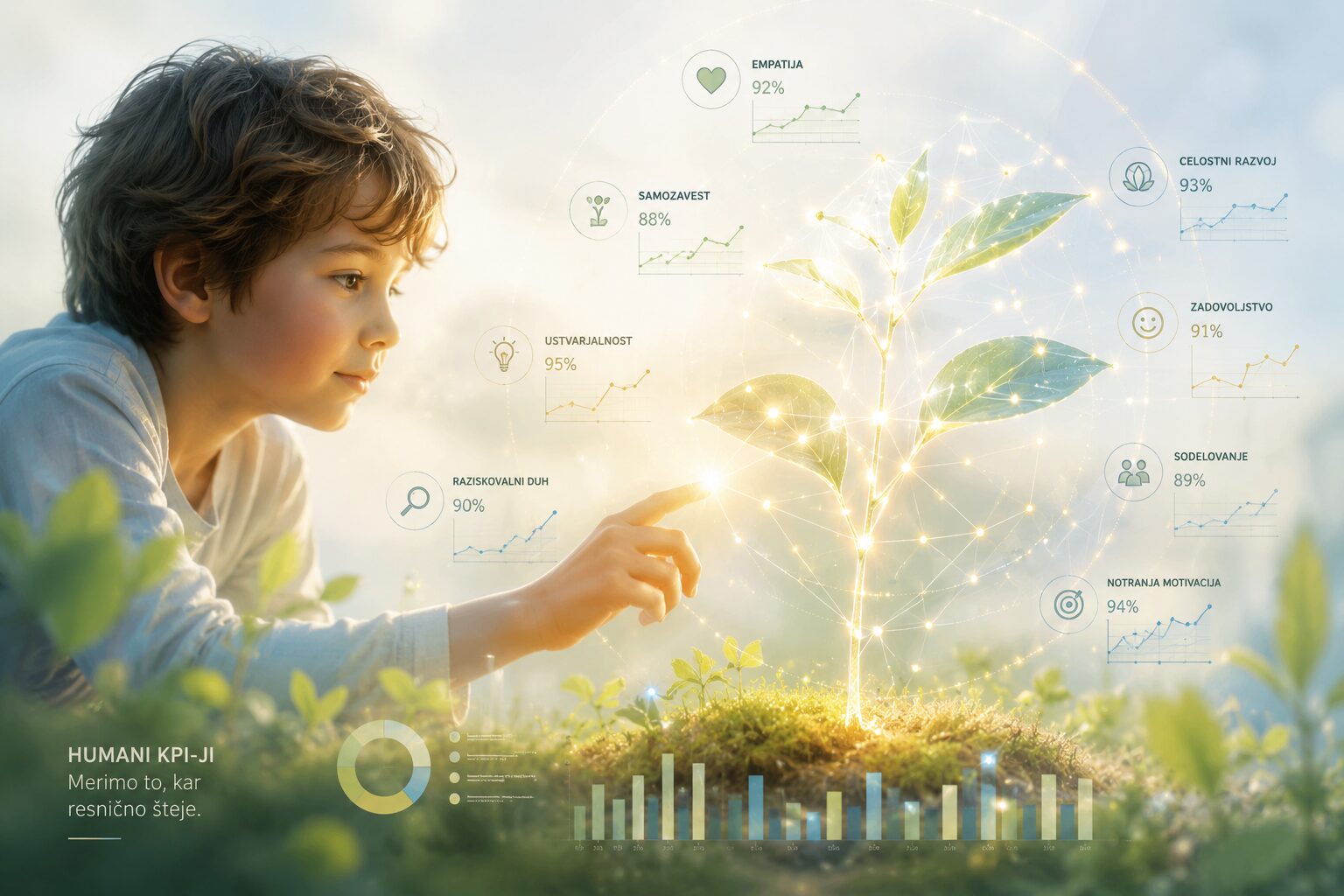
The greatest innovation of the FESAL method lies in the fact that the learner’s direct expression and self-evaluation enable the establishment of humane yet highly precise KPIs (Key Performance Indicators). These indicators do not measure merely the quantity of processed material, but instead reflect learner's a realistic picture of the expression of satisfaction of quality throughout the entire educational process. With the help of such KPIs, the Lada Center Institute can empirically demonstrate that free education does not only lead to high-level research outcomes, but primarily fosters and enables, as an environment, the emergence of confident, empathetic, and holistic individuals who operate in accordance with their full potential. These are competencies that both the economy and society are already seeking today, and will continue to seek in the future.