

INTRODUCTION
From January to
April 2025, I participated in The Learning Expedition, an online course
offered by Evolving Education. It is a personal and professional
development program focused on cultivating the mindset, skills, and tools
needed to support children and youth in developing key life skills. The course
draws inspiration from the practices of some of the world’s most progressive
learning centers.
As part of my final project, I designed an
experiment and wrote an article, which was published in the
e-magazin Transformative Learning Journeys.
You can read it here: https://drive.google.com/file/d/1RWeAwVPjuhUpfcXAuddyMwuRugK1ccaO/view
1. EDUCATIONAL PRACTICE
Over the past
year, I’ve been exploring learning
through play and experimentation. I was also deeply inspired by several
topics during the Learning Expedition, which encouraged me to dive deeper into
this field. One quote that really resonated with me was by Floris Koot: “Play is how nature invented learning.”
I’ve also drawn inspiration from Peter Gray’s work.
I carried out
two playful learning experiments with my boys, aged 4, 7, and 9:
●
One focused on learning musical
notes using salt dough.
●
The other involved
“engineering” a spinning top using snap cubes.
Kids naturally
love to create and construct—whether it’s with Legos, clay, building materials
found in nature, or even Minecraft. I often tap into their evolving interests
to prepare small “learning stations” or “morning learning invitations.”
Since my boys
are mostly kinaesthetic learners, I try to create educational setups that
involve movement and hands-on experiences. My goals are to:
●
Build lasting knowledge.
●
Make learning fun.
●
Encourage creativity.
●
Use various available
materials.
●
Nurture intrinsic motivation.
●
Follow the child’s curiosity
and interests.
In everything I
design, I aim to make learning joyful, meaningful, and rooted in real
engagement.
2. WHAT DID WE DO?
a) SALT DOUGH, MUSICAL NOTES AND SOLMIZATION SYLLABLES
My oldest son is
really interested in clay, and recently he became curious about music and
musical notes. He was highly motivated to learn the notes and solmization
syllables, which made this the perfect opportunity for an engaging and
memorable learning experience.
Since I didn’t
have any natural or artificial clay on hand, we decided to make our own salt
dough – a simple, eco- and budget-friendly option.
We used this
easy recipe:
●
250 g plain flour
●
125 g table salt
●
125 ml warm water
We measured all
the ingredients using a kitchen scale, and at the end, we added a bit of food
colouring to make the dough more fun to work with. I also created a five-line
staff using masking tape.
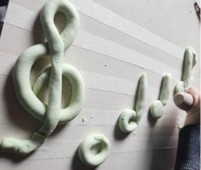
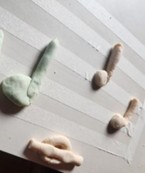
First, my son
sculpted four types of notes (whole, half, quarter, and eighth) along with a
treble clef. Then, I gave him instructions—for example: “Use the whole note, place it on the RE position, and sing it out.”
After a few turns, we switched roles and he began directing me.
By the end, both
his younger brothers joined in, and the activity became even more fun and
collaborative.
Making notes, treble clef, connecting notes positions and
solmization syllables:
a)
SNAP CUBES AND CREATING A SPINNER TOP
My boys became
really interested in spinning objects. At first, they explored a simple
electric circuit by connecting a mini fan to a battery. Then, with the help of
an elderly friend of their grandfather, they created a huge spinning fan from
recycled materials. They were also fascinated by playing with frisbees—so I got
an idea!
One morning, we
had a discussion about objects that move by spinning: windmills, fidget
spinners, computer fans, spinning tops, and more. We talked about why we use
them, how they work, and where we’ve seen them in everyday life. That
conversation sparked a new project: we would become “engineers” and build our
own spinning tops using snap cubes.
The main
objective was to construct a spinner that could spin for the longest time. We
tested each design and measured how long it spun. If a spinner didn’t work well
or didn’t spin long enough, the boys were encouraged to improve it and try
again. We used a trial-and-error approach—mistakes weren’t failures, but
opportunities to learn and improve.
We also observed
what worked well in other designs and tried to recreate successful spinner
tops. It became a fun blend of creativity, critical thinking, and playful
experimentation.
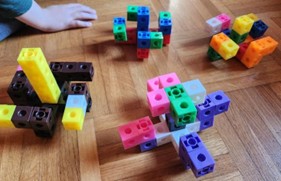
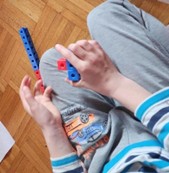
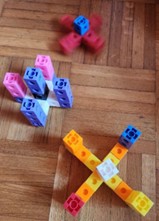
Here are some examples of our
spinners that we constructed:
3.
REFLECTION
As a
homeschooling mom, I spend a lot of time with my kids. This gives me the
opportunity to observe them closely and notice what motivates them and what
sparks their curiosity. For me, the greatest satisfaction is seeing the light
in their eyes when they discover or understand something new.
Through these
two experiences, I’ve learned:
●
Following a child’s interest is
key to keeping them motivated and curious.
●
To let them learn from their
mistakes and not interrupt the process too early.
●
The value of connecting
different learning areas—using a cross-curricular approach. In these two
experiments, we brought together art, music, science, and math.
●
How important it is to relate
learning to real life.
●
That we truly enjoy exploring
possibilities and sharing our work with others.
●
That you don’t need expensive
resources to create meaningful learning experiences.
I’m going to
continue creating these types of learning opportunities because they’re
incredibly valuable for both me and my family. They allow me to be creative in
how I design each learning unit, and they bring joy, curiosity, and connection
into our everyday lives.

